
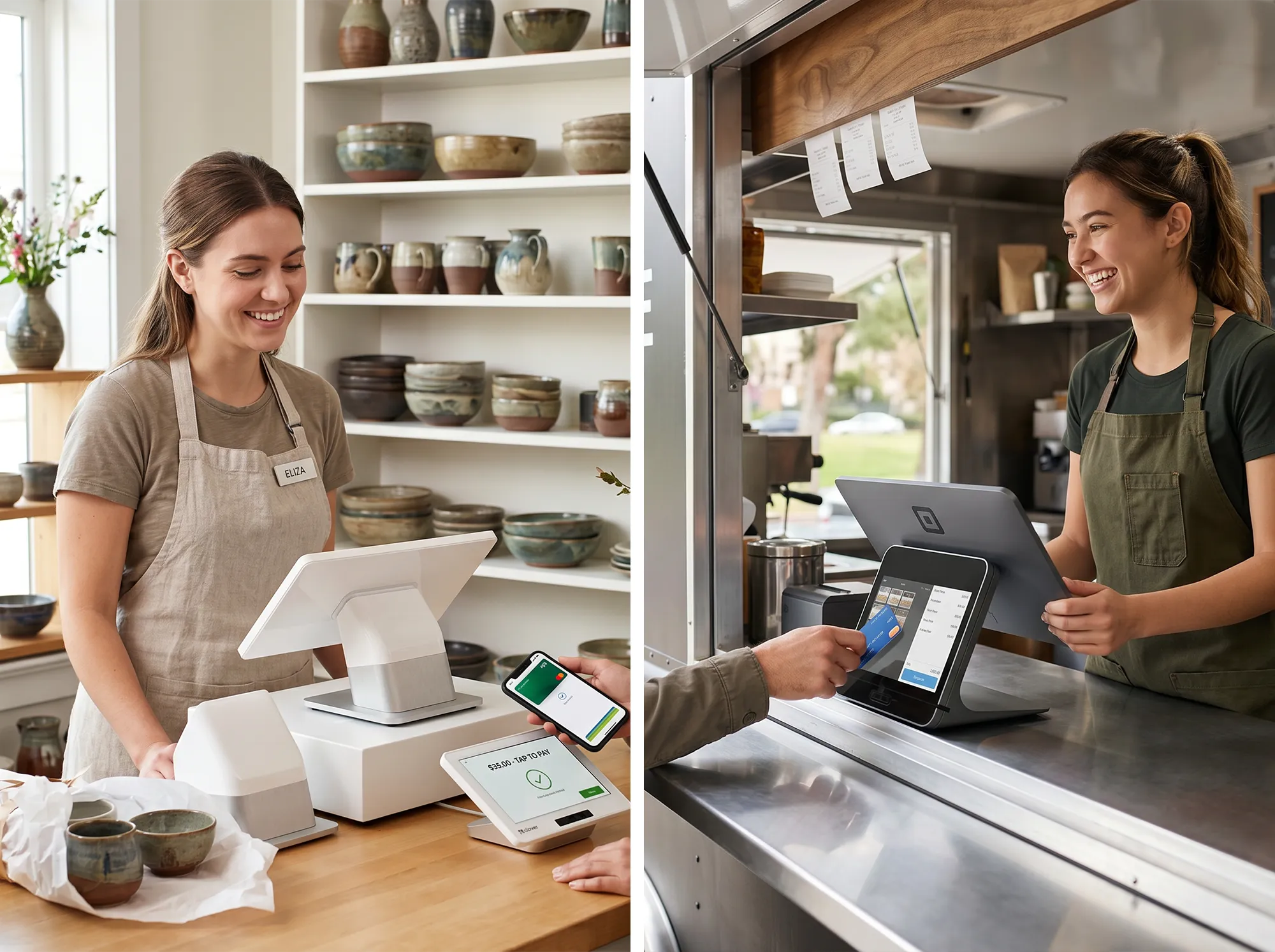
If you're a small business owner shopping for a way to take card payments, you've almost certainly run into Clover and Square. They're the two most recognizable names in the small business point-of-sale (POS) world, and for good reason — both make solid hardware, both have decent software, and both will get you taking payments quickly.
But "both are good" isn't a useful answer when you're trying to decide where to spend your money. Clover and Square take fundamentally different approaches to how they sell to you, how they charge you, and what kind of relationship you have with the company after you sign up. Those differences matter a lot more than the surface-level feature lists suggest.
This guide walks through how the two platforms actually compare in 2026 — pricing, hardware, online selling, support, contracts, and the trade-offs nobody puts in their marketing copy. The goal here isn't to crown a winner; it's to help you figure out which one fits the way your business actually runs.
The Core Difference in One Paragraph
Square is a single, vertically integrated company. Historically, you bought from Square, processed with Square, and got everything end-to-end with flat, predictable pricing and no contracts. Clover is owned by Fiserv and has always been sold through a network of banks, merchant service providers, and resellers — meaning your pricing, contract terms, and support experience can vary depending on who you buy it from. Square optimizes for simplicity. Clover optimizes for flexibility.
That distinction is starting to blur — both platforms can now be purchased through trusted resellers — but it still drives most of the differences below.
Pricing and Processing Fees
This is usually the first question on a business owner's mind, and it's also the area where the two platforms differ the most.
Square's Pricing Model
Square keeps things simple. There's a free software tier that includes basic POS, online ordering, a free website, gift cards, and integrations — no monthly fee. If you want more advanced industry-specific features, the Plus plan runs $29 per month, and there's a custom-priced Premium tier for larger operations.
Processing fees are flat-rate:
2.6% + $0.10 for card-present (in-person) transactions
3.5% + $0.15 for card-not-present (manually keyed) transactions
2.9% + $0.10 for online transactions
That's it. No tiered rates, no negotiation, no surprises. What you see is what you pay.
Clover's Pricing Model
Clover's pricing is more layered. There are six industry-specific solutions — full-service dining, quick-service dining, retail, professional services, personal services, and home/field services — and each one has Starter, Standard, and Advanced tiers. Monthly software costs run roughly $14.95 to $310 per month depending on the industry and tier.
Processing fees vary by category and tier, but generally fall in the range of:
2.3% to 2.6% + $0.10 for card-present transactions
3.5% + $0.10 for card-not-present transactions
Because Clover is sold through resellers and merchant service providers, the actual rates you're quoted can be higher or lower than Clover's published direct-from-Clover rates. Some resellers offer interchange-plus pricing, which can be cheaper than Square's flat rate at higher volumes. Others bundle in fees that make the total cost worse. The variability cuts both ways.
Which Is Actually Cheaper?
It depends on your average ticket size and monthly volume, but here's the rough breakdown:
Low-volume or new businesses: Square almost always wins on total cost because there's no monthly software fee.
Higher-volume businesses with smaller average tickets: Clover tends to come out ahead. On a $10 sale, Clover's in-person fee at 2.3% + $0.10 is about $0.33, while Square's 2.6% + $0.10 is about $0.36. The gap looks small, but multiplied across thousands of transactions, it adds up.
Businesses willing to negotiate: Clover, because the reseller model gives you room to shop around for better rates. Square's published flat rate isn't negotiable, though working with a reseller can change the overall economics through bundled services and support.
The honest takeaway: Square is more predictable, Clover is more negotiable. If you hate surprises and don't want to think about your processor again, Square's published rates are easy to budget around. If you have the volume and patience to compare quotes, Clover often beats Square on rate.
Hardware
Both companies make hardware that looks good and works well. The differences are mostly about flexibility and price.
Square Hardware
Square sells a focused, affordable lineup:
Magstripe reader — first one is free
Contactless and chip reader — $49 to $59
Square Stand for iPad — $149
Square Terminal — $299
Square Register — $799
You can also use Square with hardware you already own — a phone, tablet, or laptop — which is a real cost advantage if you're starting lean.
Clover Hardware
Clover's hardware tends to be heavier-duty and more purpose-built:
Clover Go — mobile reader for on-the-go payments
Clover Flex — handheld POS with built-in printer
Clover Mini — countertop touchscreen POS
Clover Station Solo / Station Duo — full countertop systems with customer-facing screens
Clover hardware is generally more expensive than Square's, with full systems running into four figures. The trade-off is that it's built specifically for retail and restaurant environments — sturdier, more polished, and often better suited for higher-traffic operations.
One thing worth flagging: Clover hardware is proprietary. If you decide to leave Clover, the hardware doesn't go with you to another processor. Square hardware has a similar limitation. Plan accordingly.
Online Selling and E-Commerce
If selling online matters to your business, this is a significant difference.
Square includes a free online store builder with its base plan — pre-built themes, online ordering, and inventory that syncs across in-person and online sales. For a business that wants to be selling on day one without paying extra, that's a meaningful advantage.
Clover does not include a built-in online store. It offers Clover Online Ordering, which can be embedded into an existing website, but if you want a full e-commerce site you'll need to integrate Clover with a third-party builder like Squarespace, Wix, or BigCommerce. That adds cost and setup time.
If e-commerce is central to your plans, Square has the easier path. If you already have a website (or you're hiring someone to build one) and you mainly need a POS for in-person sales, this difference may not matter to you.
Invoicing, Marketing, and Add-Ons
Both platforms handle invoicing well. You can create invoices, send them by email, accept online payments, and set up recurring billing on either system. Square has a slight edge in convenience — you can send invoices via SMS with payment links — while Clover's invoicing is part of its broader, more security-focused ecosystem.
Where they diverge is marketing. Square offers built-in email marketing (starting at $10/month) and text message marketing ($15/month) as add-ons, with templates, automation, and analytics tied directly to your customer data. Clover doesn't offer marketing tools directly; you'd integrate with a third-party app from the Clover App Market.
For a business that wants marketing built into the same dashboard as sales, Square is the more complete package. For a business that already has marketing handled elsewhere, this won't move the needle.
Customer Support: The Hidden Variable
This is the area most comparison articles oversimplify, and it's where the platforms have historically diverged the most.
Clover offers 24/7 phone and email support, plus live chat, with response times typically under 20 minutes. Because Clover is sold through resellers, many Clover customers also have a local point of contact who knows their business — someone who can step in when the corporate support line isn't enough.
Square offers phone, email, and live chat support Monday through Friday, 9 a.m. to 9 p.m. ET. Historically, Square's support model has been entirely direct — you call Square, you wait for Square — and response times in customer reviews have ranged from a couple of hours to a full day for support tickets. There's also a structural quirk worth knowing about: because Square is the merchant of record for its users (meaning every Square user processes through one big aggregated merchant account), Square is more cautious about flagged transactions. Account holds and freezes are a known friction point, particularly for businesses with sudden volume spikes or unusual transaction patterns.
Here's what's changing in 2026: Square is starting to allow trusted resellers to sit between the platform and the merchant, which means some Square customers can now have the same kind of local support relationship that Clover customers have always had. That's a meaningful shift, and it's worth understanding before you decide.
Contracts and Commitment
Square, purchased directly, is month-to-month with no contracts and no early termination fees.
Clover depends entirely on who you buy it from. Clover purchased directly often comes with reasonable terms, but many resellers require multi-year contracts with early termination fees that can run into the hundreds or thousands of dollars. This is one of the most common complaints about Clover, and it's worth reading any contract carefully before signing.
A reputable reseller — for either platform — will be transparent about contract length, termination fees, and what happens if you want to leave. A bad one will bury those terms in the fine print. Read carefully.
When Square Is the Better Fit
Square tends to be the right choice if:
You're brand new and want to start taking payments today
Your sales volume is low or unpredictable
You need a free or cheap online store built in
You value flat-rate pricing that's easy to budget around
You'd rather use existing devices (phone/tablet) than buy new hardware
Your customers are mostly online or mobile
When Clover Is the Better Fit
Clover tends to be the right choice if:
You have meaningful in-person sales volume (especially restaurants or retail)
You want your own dedicated merchant account, not an aggregated one
You need industry-specific features (kitchen displays, table management, etc.)
You want hardware purpose-built for high-traffic environments
You value the option to negotiate rates
No call required
See what you’d actually pay on Square or Clover
Send us your last statement or just your monthly card volume. We’ll send back a side-by-side rate comparison, including whether dual pricing could zero out your fees. No call, no commitment.
The Question Most Comparisons Skip: Who You Buy It From
If you've read this far, you've probably noticed that a lot of the real differences between Clover and Square — pricing, contract terms, support quality — depend less on the platforms themselves and more on how and where you buy them.
Two Clover customers can have completely different experiences. One pays 2.3% + $0.10 with no contract; another pays 2.9% + $0.15 locked into a three-year deal with $500 in early termination fees. Same hardware, same software, totally different financial outcomes.
Until recently, Square didn't have this problem because there was only one way to buy Square: directly. That was a strength (consistency) and a weakness (no human in your corner when something went wrong). The 2026 shift toward reseller partnerships is changing that, and it means the decision in front of small business owners is no longer just "Clover or Square?" — it's also "do I want to navigate this on my own, or do I want someone in my corner?"
Where SimpliPay Fits In
SimpliPay is a payments consulting firm based in Fort Lauderdale, Florida, and we're a reseller for both Clover and Square — which means our recommendation isn't tied to one platform. We can set you up on whichever one actually fits your business better, and we don't make our money by pushing one over the other.
What we do that the platforms don't:
We act as your point of contact. When something goes wrong — a chargeback question, an account hold, a piece of hardware that won't behave, a confusing fee on your statement — you call us, not a corporate support line. We handle the back-and-forth with the platform on your behalf and get you to the answer faster than you'd get to it alone. This applies whether you're on Clover or Square; we're in your corner for either one.
We help you avoid the wrong setup. Choosing between Clover and Square is one decision. Choosing the right plan, the right hardware, and the right pricing model within that platform is several more — and the wrong choice can cost you thousands a year. We walk through the actual numbers with you before you sign anything.
We offer dual pricing where it makes sense. Through dual pricing, the cost of card processing is passed transparently to customers paying by card, while cash customers pay the listed price. For businesses with thin margins — restaurants and retail in particular — this can effectively eliminate processing fees from your bottom line. Dual pricing isn't right for every business, and we'll tell you when it isn't.
No long-term contracts. Cancel with 30 days' notice. That's a meaningful contrast with the multi-year contracts some resellers require.
Same-day approval and local human support. Setup takes minutes rather than weeks, and when you call, you reach a real person who knows your account.
The honest framing: Clover and Square are both good platforms. The difference between a great experience and a frustrating one usually isn't which platform you chose — it's whether you have someone to call when something doesn't go to plan. That's the gap we step into.
No call required
See what you’d actually pay on Square or Clover
Send us your last statement or just your monthly card volume. We’ll send back a side-by-side rate comparison, including whether dual pricing could zero out your fees. No call, no commitment.
The Bottom Line
There's no universally better option between Clover and Square. There's only the option that fits your business better.
Square is the easier on-ramp — flat pricing, free to start, and a complete ecosystem if you want everything from one company. Clover is the more flexible, more powerful platform — better hardware, more industry-specific features, and better rates if the setup is right.
The mistake most business owners make isn't picking the "wrong" one. It's picking either one without asking the right questions about volume, contract terms, support, and total cost over time. Whichever direction you go, take an extra hour to compare a couple of quotes and read the fine print — or talk to someone who can walk through it with you.
If you want that conversation, we're here.
Sources and further reading: Business.com — Clover vs. Square, NerdWallet — Clover vs. Square 2026, Merchant Maverick — Clover vs. Square, TechnologyAdvice — Clover vs. Square POS.